
What is a Good Size Diamond for an Engagement Ring?
Choosing the perfect center stone for an engagement ring often feels like a balancing act between desire and budget. You likely have questions about what is considered normal, impressive, or excessive. Most buyers immediately ask what is a good size diamond for an engagement ring, hoping for a specific number. The reality is that the “right” size depends heavily on personal preference, budget constraints, and where you live.
The concept of a good size is subjective, but data helps clarify the picture. In the United States, the average diamond size for an engagement ring in Revere typically falls between 1.0 and 1.2 carats. This range offers a substantial look without reaching into celebrity price brackets. However, as the experts at Boston Ring and Gem (BRAG) will tell you, averages only tell part of the story. A one-carat stone might look massive in a small town but modest in a major metropolitan area.
You should also consider that carat weight does not strictly equal visual size. Two diamonds with the exact same weight can have different physical dimensions based on how they are cut. Understanding these nuances, something Boston Ring and Gem specializes in explaining during their private consultations, allows you to maximize the visual impact of the ring. This guide examines the factors that influence size perception and value to help you make an informed decision.
The National Average and Cultural Expectations
Social context plays a significant role in how we perceive diamond size. While the national average hovers around one carat, regional norms vary drastically. In many European countries, a 0.50-carat diamond is considered substantial and elegant. Conversely, in certain circles within the United States, expectations may push toward 2.0 carats or larger.
You should consider the wearer’s lifestyle and social circle when determining a good size. An extremely large diamond might be impractical for someone who works with their hands or wears gloves daily. A high-profile stone can snag on clothing or feel heavy during daily activities. Practicality is just as important as aesthetics when wearing a piece of jewelry every single day.
Age also correlates with diamond size preferences and budget capabilities. Older couples who are further along in their careers often opt for larger stones compared to younger couples just starting out. There is no rule stating you must match the average. Many clients at Boston Ring and Gem prioritize quality over size, choosing a smaller but flawless diamond that sparkles intensely, often set in one of BRAG’s signature custom mountings to enhance its beauty.
Carat Weight Versus Visual Size
A common misconception is that carat refers to the physical size of the diamond. Carat is actually a unit of weight, equal to 200 milligrams. While heavier diamonds are generally larger, the cut and shape greatly influence the visible surface area. A “good size” diamond is one that faces up large for its weight.
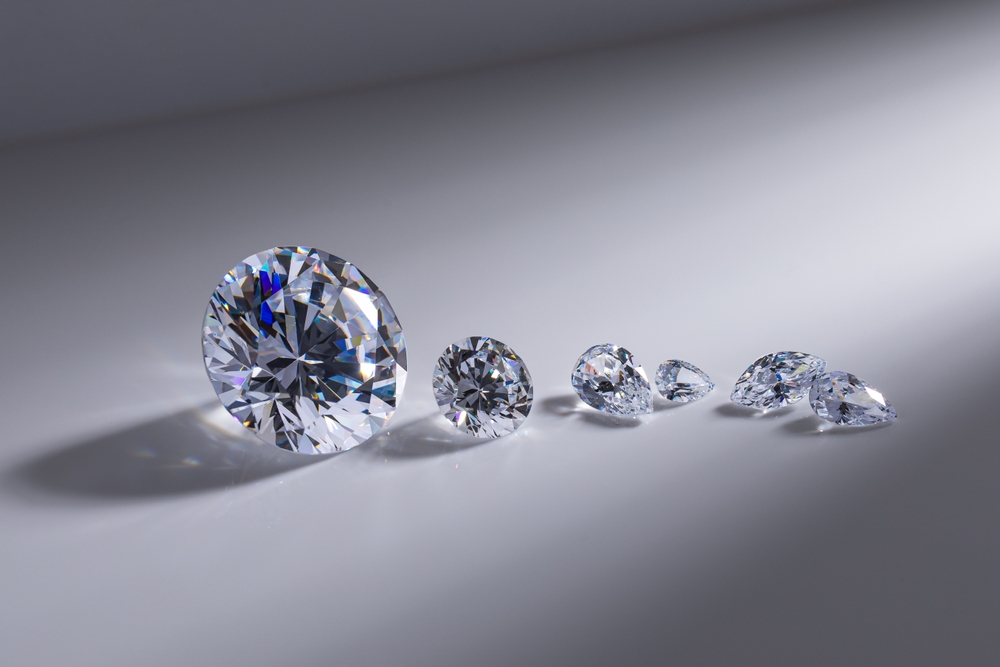
Different diamond shapes carry their weight differently. Elongated shapes like ovals, pears, and marquises often appear larger than round brilliant cuts of the same carat weight. This happens because these shapes have a larger table (top surface) and are not as deep. If maximizing visual impact is your goal, Boston Ring and Gem often recommends exploring these fancy shapes over a traditional round cut.
Cut quality also dictates how large a round diamond appears. A diamond cut too deep hides its weight in the bottom of the stone where you cannot see it. A diamond cut too shallow might look wide, but it will lack brilliance and look glassy. An “Ideal” or “Excellent” cut grade guarantees the diamond reflects light properly, which can actually make the stone appear larger and brighter to the naked eye.
Finger Proportions and Coverage
The size of the wearer’s hand dramatically affects how a diamond looks. A 1.0-carat diamond will look significantly larger on a size 4 finger than it will on a size 8 finger. This optical effect is known as “finger coverage.” You can achieve a luxurious look with a smaller carat weight if the wearer has slender fingers.
To determine what looks best, consider the percentage of the finger width the diamond covers. Many jewelers suggest that a stone covering about 40% to 50% of the finger’s width looks substantial and balanced. For a size 6 finger, a 1.5-carat round diamond typically achieves this look. If the finger is a size 4, a 1.0-carat stone provides nearly the same coverage percentage.
You can use this knowledge to your advantage during the buying process. If the ring size is small, you do not need to overspend on a massive rock to get a “big” look. Conversely, for larger hands, you might explore the custom design options at Boston Ring and Gem, such as halo settings or three-stone rings. These styles add overall width to the ring without requiring a single, massive center diamond.
Pro Tip: Choose a thin band (around 1.8mm to 2.0mm) to make the center diamond appear larger by contrast. Boston Ring and Gem is known for their exquisite micro-pave work that keeps the focus strictly on the center stone.
Balancing the 4Cs to Maximize Size
Most buyers work within a fixed budget, meaning trade-offs are necessary. The 4Cs—Cut, Color, Clarity, and Carat—all compete for your dollars. To get a larger diamond, you usually have to compromise on color or clarity. The trick is knowing how far you can drop these grades without negatively affecting the stone’s beauty.
Prioritizing Cut Over Everything You should never sacrifice cut quality to gain size. A large but poorly cut diamond will look dull, lifeless, and often smaller than it actually is because it doesn’t reflect light to the edges. A smaller, well-cut diamond will sparkle across its entire surface, drawing the eye and creating a bigger presence. Stick to “Excellent” or “Ideal” cut grades regardless of the carat weight.
Compromising on Color and Clarity You can often drop the color grade to G, H, or even I without the diamond looking yellow, especially in yellow gold settings. Similarly, clarity grades like VS2 or SI1 are usually “eye-clean,” meaning imperfections are invisible without magnification. By choosing an H-color, SI1-clarity diamond instead of a D-color, Flawless one, you can often afford a significantly larger stone. This strategy puts your money where it is most visible: the size.
Lab-Grown Diamonds: A Size Hack
The rise of lab-grown diamonds in Boston has completely shifted the atmosphere of diamond sizes. Lab-grown diamonds are chemically and physically identical to natural diamonds but cost 30% to 50% less. This price difference allows buyers to purchase much larger stones for the same budget.
Boston Ring and Gem offers a robust selection of both natural and lab-grown diamonds, allowing clients to compare them side-by-side. With a budget that might buy a 1.0-carat natural diamond, you could likely purchase a 2.0-carat lab-grown diamond of superior quality. This option appeals to couples who prioritize the “wow” factor and visual impact over the rarity of a natural stone. It essentially removes the budget constraint that keeps many people under the 1-carat mark.
However, you should discuss this choice with your partner before buying. Some people hold sentimental value in natural stones and prefer a smaller natural diamond over a larger lab-created one. If size is the primary goal, lab-grown is objectively the most efficient route.
Strategic Buying: Magic Weights
Diamond prices do not increase in a smooth, linear line. Instead, they jump drastically at specific “magic weights” like 0.50, 1.00, 1.50, and 2.00 carats. A 1.00-carat diamond costs significantly more than a 0.90-carat diamond, even though the visual difference is virtually impossible to detect with the naked eye.
You can save a substantial amount of money by buying “shy” of the magic weight. Look for diamonds in the 0.90–0.98 carat range or the 1.40–1.48 carat range. These stones trade at a lower price per carat because they didn’t hit the benchmark weight. This strategy frees up the budget to improve the cut or clarity, or simply saves you money.
Warning: Be careful with diamonds cut specifically to hit a magic weight (like exactly 1.00 carats). Cutters sometimes leave excess weight in the girdle to reach the 1.00 mark, resulting in a stone that looks smaller than a well-cut 0.90 carat diamond.
Conclusion
Determining what is a good size diamond for an engagement ring in Medford ultimately leads back to your personal situation. While the 1-carat mark serves as a standard benchmark in the US, it is not a requirement for a beautiful ring. Factors like finger size, cut quality, and setting style all play massive roles in how impressive the ring looks on the hand.
Focus on what the diamond looks like rather than the number on the certificate. A sparkling, lively 0.90-carat stone will always garner more compliments than a dull, included 1.5-carat stone. By utilizing the expertise of a trusted jeweler like Boston Ring and Gem, you can find a diamond that feels perfect for your partner and fits comfortably within your financial plans.
