
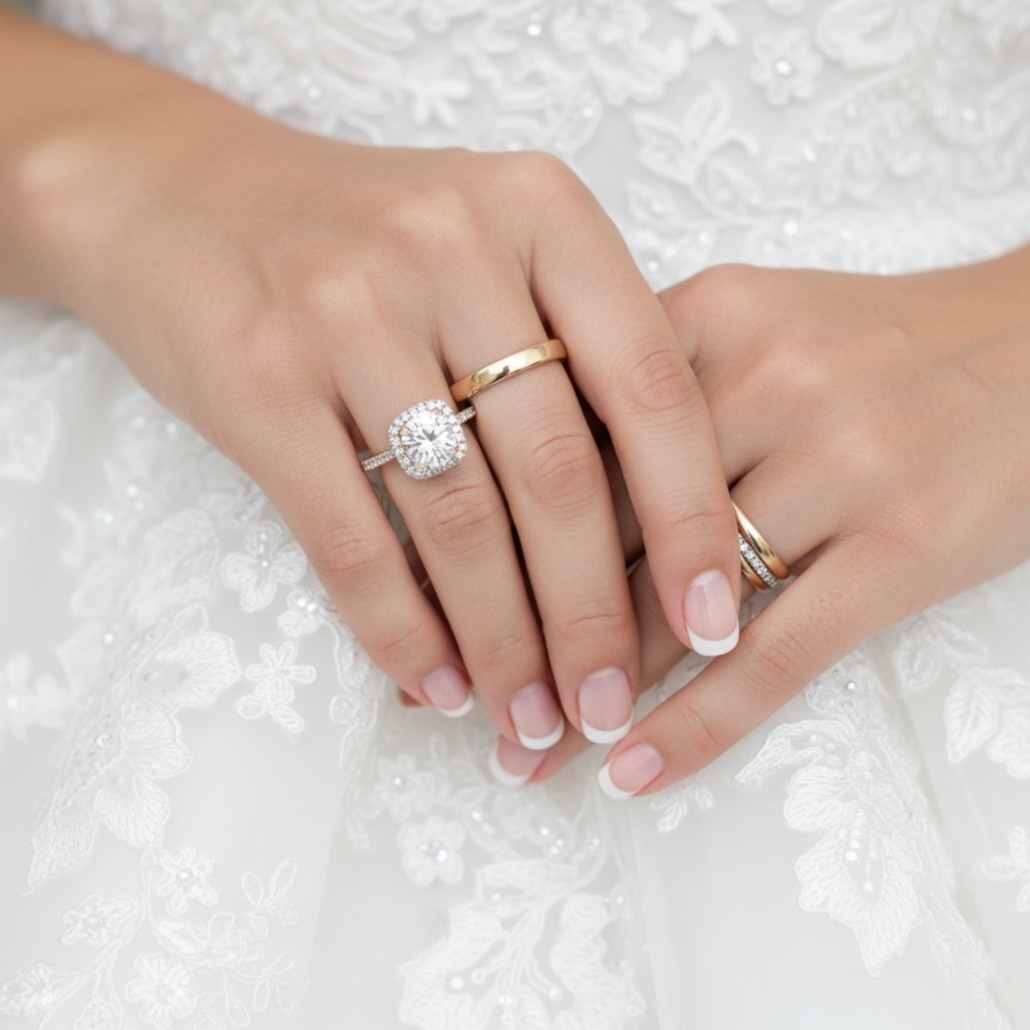
The Science of Fine Gold: Why In-House Alloy Casting Makes Stronger Engagement Rings
Most shoppers compare diamonds first and metal second, which is understandable but backwards in one aspect: the alloy holding the stone determines whether that stone stays put for fifty years. Fine Gold in its pure state is soft enough to dent with a fingernail, so every Engagement Ring depends on a careful recipe of added metals and a controlled casting process. At Boston Ring and Gem, alloying and casting happen under one roof, and the difference shows up in prolonged life, shank strength and finish quality.
What “Fine Gold” Actually Means
Fine gold is gold near total purity, expressed as 24 karat or 999 parts per thousand. The karat scale is simply a fraction out of 24, so the math behind common jewelry alloys is straightforward.
- 24K: 99.9% gold, roughly 20 to 25 on the Vickers hardness scale, too soft for stone setting
- 18K: 75.0% gold (stamped 750), richer color, moderate hardness
- 14K: 58.3% gold (stamped 585), the most common choice for American bridal jewelry
- 10K: 41.7% gold (stamped 417), the legal minimum that may be called gold in the United States
Why Pure Gold Cannot Hold a Diamond
Gold is remarkably ductile. A single gram can be drawn into wire more than two kilometers long, which is wonderful for goldsmithing and terrible for prongs. A prong made of fine gold would bend open in a coat pocket.
Adding other metals changes the crystal structure of the material and raises hardness dramatically. Cast 14K yellow gold typically measures around 120 to 150 HV, while 18K yellow lands in a similar range depending on the exact recipe and whether the piece was heat treated. That single change is what allows four slender prongs to grip a two carat stone through years of daily wear.
The Alloy Recipe Behind Each Color
Color and strength come from the same decision. What gets mixed into the fine gold determines both the hue and the mechanical behavior of the finished ring.
- Yellow gold: roughly balanced silver and copper, producing warm color and predictable workability
- Rose gold: copper heavy, which raises hardness noticeably but makes the alloy more prone to cracking if worked cold
- White gold: palladium or nickel plus zinc, then finished with rhodium plating for a bright white surface
- Green and pale golds: silver dominant, softer and less common in bridal work
Trace additions matter more than their tiny percentages suggest. Grain refiners such as iridium or ruthenium, added at only 0.005 to 0.01 percent, keep the metal’s crystal grains small during solidification. Small grains mean a tougher, more polishable surface and fewer weak boundaries where cracks begin. Readers weighing warm tones can compare the practical differences in our guide to choosing between yellow gold and rose gold.
Casting Is Where Rings Are Won or Lost
Nearly all modern engagement rings begin as lost wax castings. A wax model is invested in a plaster-like mold, the wax is burned out, and molten metal fills the cavity. Gold melts at 1,948 degrees Fahrenheit, and alloys pour somewhere between 1,750 and 2,000 degrees depending on the karat and color.
Several variables have to line up in that short window:
- Metal temperature: too cold and the metal freezes before filling thin prongs, too hot and it absorbs gases
- Flask temperature: commonly 900 to 1,200 degrees Fahrenheit, matched to the thickness of the design
- Atmosphere: vacuum or inert gas casting prevents oxygen from creating oxide inclusions
- Fresh metal ratio: reusing too much scrap concentrates oxides and depletes the trace grain refiners
- Cooling rate: controlled solidification limits shrinkage voids in heavy sections such as the shank
When those variables drift, the result is porosity: microscopic gas bubbles and shrinkage cavities inside the metal. Porosity is invisible under a fresh polish and shows itself two years later as tiny black pits, a prong that snaps while being tightened, or a shank that cracks during a routine resize.
In-House Casting Versus Outsourced Production
Many retailers order finished castings from third party houses that pour hundreds of pieces per shift with mixed scrap and generic alloy. The economics work, but nobody in that chain has seen the ring the customer actually chose. Casting on site changes the feedback loop in ways that are easy to describe and hard to fake:
- The alloy is mixed for the specific design, so a delicate pave band and a heavy signet do not receive identical metal
- Sprue placement and flask orientation are adjusted for the actual wax, improving metal flow into prongs
- A questionable casting is scrapped the same morning rather than polished and shipped
- Turnaround for a custom setting typically runs two to four weeks instead of six to ten
- Repairs, resizes and future upgrades are performed by the same bench that made the piece
That control also supports genuinely one of a kind work, which is the reasoning behind commissioning a custom engagement ring rather than adapting a stock mounting.
Choosing a Karat for Daily Wear
For most couples shopping for engagement rings in Boston, 14K is the practical default. It resists deformation slightly better than 18K in thin sections, costs significantly less, and holds up well against granite countertops, gym equipment, or any other hazards you may cross.
18K makes sense when color depth is the priority, when the wearer is sensitive to nickel bearing alloys, or when the design uses substantial metal that will not flex. Platinum sits in a different category entirely, and the tradeoffs are laid out in our comparison of white gold versus platinum. Clients often start by browsing settings in person at our showroom, whether they are shopping for engagement rings in Brookline, or wedding bands across the city, Boston Ring and Gem has you covered.
How to Inspect Metal Quality Yourself
You do not need a metallurgy background to spot warning signs. A ten power loupe and good light reveal most of it.
- Look for pinpoint pits along the inside of the shank and beside the prongs
- Check that prong tips are rounded and even, not thinned to slivers by heavy polishing that hid porosity
- Confirm a clear karat stamp and a maker’s mark inside the band
- Press gently on the head and watch for any flex between the setting and the shank
- Ask directly where the ring was cast and whether the alloy was mixed for that piece
Frequently Asked Questions
Is 14K gold stronger than 18K gold?
Yes, 14K gold is generally harder, typically measuring around 120 to 150 HV compared with a softer range for many 18K yellow alloys. The added copper and silver in 14K raise resistance to bending and abrasion, which is why it dominates American bridal jewelry.
What does 585 or 750 stamped inside a ring mean?
585 means the metal is 58.3% pure gold, or 14 karat, and 750 means 75.0%, or 18 karat. Both figures express fineness in parts per thousand, and United States law requires accurate karat marking on any piece sold as gold.
Can porosity in a cast ring be repaired?
Small surface pits can sometimes be laser welded and refinished, but widespread internal porosity usually cannot be fixed and calls for recasting. This is why the casting stage deserves as much attention as the stone selection.
How often does white gold need rhodium replating?
Most white gold engagement rings benefit from replating every 12 to 24 months, depending on skin chemistry and how often the ring is worn during chores. The plating is a surface finish over a slightly warm toned alloy, so wear appears gradually rather than all at once.
Does recycled gold make a weaker ring?
Recycled gold refined back to fine gold performs identically to newly mined metal. Problems arise only when unrefined bench scrap is remelted repeatedly, since oxides accumulate and grain refiners are lost.
See The Difference in Person Today
Bring in a ring you already own and we will show you, under the loupe, exactly what alloy quality and clean casting look like. Contact Boston Ring and Gem to book a consultation to plan a setting that will still be tight decades from now.

