
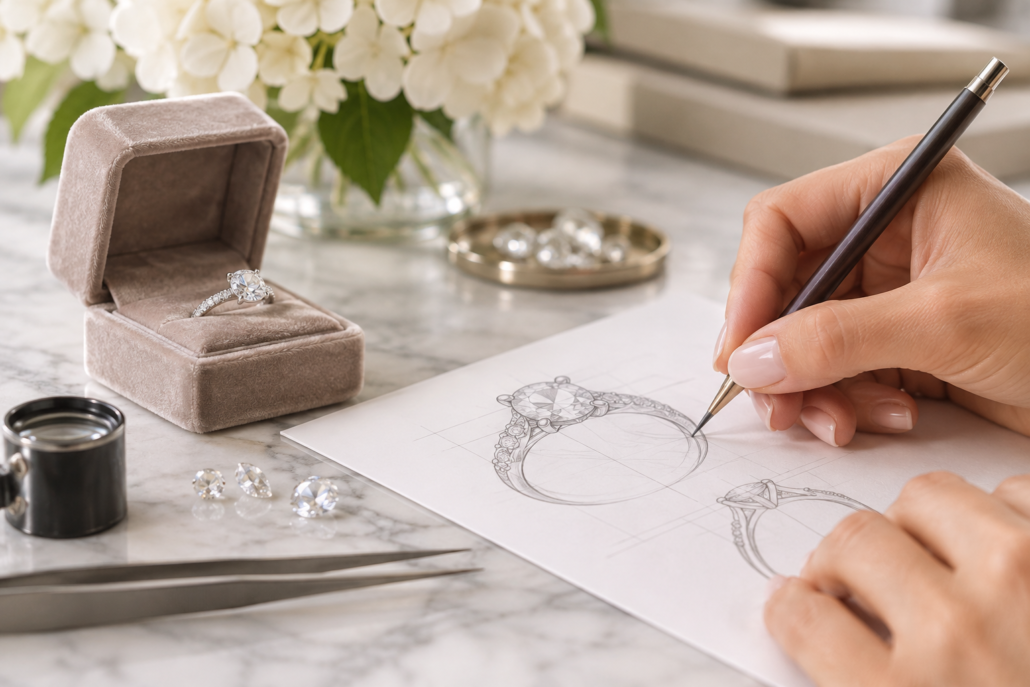
The Art of Custom Jewelry Design: Bringing Your Dream Engagement Ring to Life
Custom engagement ring design is a guided collaboration between you and a bench jeweler that usually takes four to eight weeks: consultation, stone selection, CAD rendering, a 3D-printed model, casting, then hand setting and finishing. Most couples spend roughly what a comparable retail ring costs, because the budget goes into the design they actually want rather than inventory someone else chose.
How Custom Design Differs From Buying Off the Case
A custom ring is built around one stone, one finger, and one set of preferences, while a case ring is made in standard sizes and proportions for the broadest possible audience. The difference shows up in the details: gallery height, prong thickness, how the band meets the center setting.
That matters more than most people expect. A 1.5 carat oval in a setting designed for a round diamond will sit with visible gaps at the ends, and a cathedral shoulder built for a size 7 finger looks heavy on a size 4.5. Custom work corrects those proportions before any metal is poured.
Couples also come to custom design for reasons the showcase cannot solve: an unusual stone shape, a family diamond, a left-handed wearer who needs a lower profile, or a design that has to sit flush against an existing wedding band.
What Happens in the First Consultation
The first meeting is a conversation about budget, timeline, stone preference, and daily wear, and it typically lasts 45 to 90 minutes. You leave with a direction, a rough price range and a sense of what is realistic in that range.
Bring anything that helps a jeweler read your taste: screenshots, a photo of a grandmother’s ring, a short video of a style you keep rewatching. Images of what you dislike are just as useful, since “too chunky” means very different things to different people.
- Budget range, stated honestly, so stone size and metal choice get balanced correctly from the start
- Ring size, or a borrowed ring that fits the right finger
- Lifestyle notes: nursing, rock climbing, gardening, gloves at work, frequent hand washing
- Wedding band plans, because a contoured band is far easier to design alongside the engagement ring than after it
Many studios now run this stage by video call for clients who cannot get in during business hours, then confirm measurements in person later. Couples shopping for engagement rings in Newton, MA often start with a remote consultation and come in once the design is close.
Choosing the Center Stone: Natural, Lab-Grown or Heirloom
The center stone usually sets 40 to 70 percent of the total budget, so it gets chosen before the setting design is finalized. Natural diamonds, lab-grown diamonds, and colored gems each change the math significantly.
Lab-grown diamonds of equal grade generally cost 60 to 85 percent less than their natural counterparts, which is why so many couples use them to move up in size or quality. Sapphires, moissanite and moss agate open other directions entirely, though hardness matters for daily wear. Ask to see the grading report and read how the 4Cs are actually assessed rather than relying on marketing language.
Heirloom stones deserve their own conversation. An old European cut from 1920 has different proportions and a softer sparkle than a modern brilliant, and settings have to be drawn around that. Our guide to restyling heirloom jewelry into modern custom rings walks through what can and cannot be reused safely.
How CAD and 3D Models Let You See the Ring First
Computer aided design turns the sketch into a precise 3D file, usually within three to seven business days, and you review photorealistic renderings before anything is made. Most studios include two or three revision rounds at no extra cost.
A good CAD presentation showcases the ring from the top, the side and at an angle, often as a short rotating video so you can judge the profile height. That side view is the one people skip and later regret, since it determines whether the ring clears a wedding band and how far the stone sits off the finger.
After approval, the file is printed in castable resin. Holding that model, even in plastic, answers questions no screen can: whether a three-stone design reads as balanced, whether the band width feels right, whether the halo is doing too much.
Designing for the Hand That Will Wear It
The most overlooked part of custom work is fitting the design to the wearer’s hand, not just to the stone. Finger length, knuckle size, and skin tone all change how a finished ring looks and feels.
A few adjustments that rarely appear in online configurators:
- Band width scaled to finger size: a 2mm band that looks delicate on a size 5 can disappear on a size 9
- Lower profile settings for people who snag rings on clothing, sleeves, or steering wheels
- Sizing beads or an open shank for a large knuckle with a slim base finger
- Prong count and thickness adjusted for soft stones or active hands, often six prongs instead of four
- Elongated stone orientation, since an oval or marquise set lengthwise flatters shorter fingers
Comfort is measurable, and it is worth testing before casting. Our piece on how an engagement ring should actually feel explains the difference between a ring that fits and one that merely goes on.
At the Bench: Casting, Setting and Finishing
Fabrication takes roughly two to four weeks and happens in stages: the resin model is cast in gold or platinum, the raw casting is filed and pre-polished, stones are set by hand, then the piece is finished and rhodium plated if it is white gold.
Setting is the step where skill shows most. A setter raises, trims, and burnishes each prong individually under magnification, and pavé work on a single band can involve 40 to 90 stones placed one at a time.
Metal choice affects both the bench work and the long term. Platinum is denser and holds prongs more securely but scratches into a patina, while 14k and 18k gold polish brighter and cost less per gram. Federal jewelry marking and disclosure rules require accurate karat stamping, so ask where and how your ring will be hallmarked.
What a Custom Engagement Ring Typically Costs
Most custom engagement rings run between $2,500 and $12,000 in 2026, with the setting itself usually accounting for $900 to $3,500 depending on metal weight, accent stones, and complexity. Design and CAD fees, when charged separately, commonly fall between $150 and $500 and are often credited toward the final piece.
Custom does not automatically mean more expensive. Because you are not paying for a finished ring sitting in a case, a comparable design frequently lands at or slightly below retail, and lab-grown center stones push that further.
Price ranges shift with the market, so treat any quote as valid for a set window. Clients comparing engagement rings in Brockton, MA and engagement rings in Lynn, MA often find the gap between custom and in-stock is smaller than expected once the stone is matched grade for grade.
Frequently Asked Questions
How Long Does It Take to Create a Custom Engagement Ring?
Four to eight weeks is typical, with rush work possible in two to three weeks for an added fee. CAD and revisions take about one week, casting and setting take two to four, and sourcing an unusual stone can add another one to two weeks.
Can I Design My Own Ring Without Knowing Anything About Jewelry?
Yes, and most clients start with nothing more than a handful of saved images. The jeweler’s job is to translate preferences into proportions, which is why the CAD stage exists before any metal is committed.
Can I Use a Family Diamond in a New Setting?
In most cases, yes, provided the stone is examined first for chips, abrasions, and internal fractures near the girdle. Older stones sometimes need recutting of a few tenths of a carat, and the jeweler should document the stone’s weight and condition before removing it from its original mounting.
Is a Custom Ring Harder to Insure or Appraise?
No, and it is often easier, because a custom piece comes with a documented design file, a grading report for the center stone, and a retail replacement appraisal. Insurers generally want an appraisal dated within the past two to three years.
How Often Should a Custom Engagement Ring Be Checked?
Every six months for prong and setting inspection, and roughly every 12 to 18 months for professional cleaning and rhodium replating on white gold. Daily wear loosens prongs gradually, and a two-minute check catches it long before a stone moves.
Start Your Custom Ring Design
Bring your inspiration, a budget range and a family stone if you have one, and we will sketch the direction in the first sitting. Contact Sevag Zargarian to book a consultation in person or by video and see your design in CAD before a single prong is cut.
