
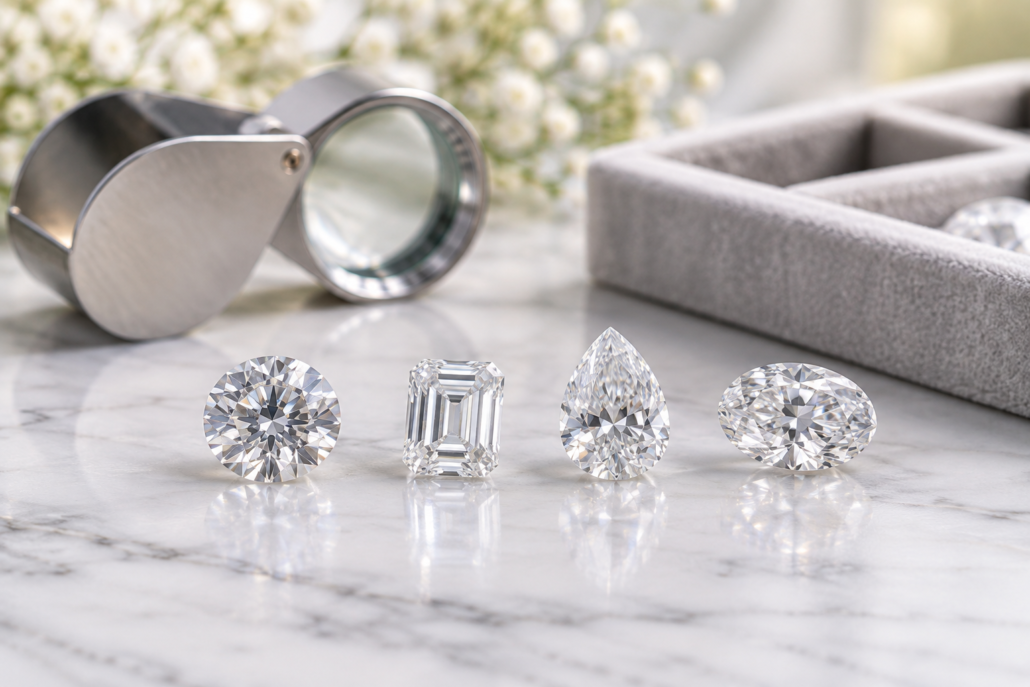
Understanding the 4 Cs: A Beginner’s Guide to Diamond Quality and Brilliance
The 4 Cs are cut, color, clarity, and carat weight, and they are the four grading factors that decide both how a diamond looks and what it costs. Of the four, cut has the largest effect on brilliance, which is why two one-carat diamonds with identical color and clarity grades can look noticeably different across a counter. Understanding the 4 Cs is mostly about learning where your money buys visible beauty and where it buys a line on a report.
Cut Is the C That Controls Sparkle
Cut grades a round diamond’s proportions, symmetry, and polish, not its shape. A stone cut to ideal angles returns light through the top; a stone cut too deep or too shallow leaks light out the bottom and looks glassy or dark in the center. The GIA cut scale runs Excellent, Very Good, Good, Fair, and Poor, and it is only assigned to round brilliants.
For round diamonds, the proportions most closely tied to strong light return fall in fairly narrow ranges:
- Table percentage of roughly 54 to 58 percent
- Total depth of about 59 to 62.5 percent
- Crown angle near 34 to 35 degrees
- Polish and symmetry graded Excellent or Very Good
Fancy shapes (oval, emerald, pear, cushion) do not receive an overall cut grade from GIA, so you judge them by eye and by proportions. With ovals and pears, the thing to watch for is the bowtie, a dark band across the center caused by the stone shadowing itself. A faint bowtie is normal; a heavy black one does not disappear under any lighting.
Color Is Graded on an Absence Scale From D to Z
Diamond color measures how little body color a stone has, with D as colorless and Z showing a light yellow or brown tint. The grades are grouped as colorless (D, E, F), near colorless (G, H, I, J), faint (K through M) and beyond. Most people cannot tell a D from a G once the stone is set and viewed face up.
The setting metal matters more than buyers expect. In platinum or white gold, G or H usually looks white without paying the colorless premium, which can run 15 to 25 percent over a near colorless grade. In yellow or rose gold, J and even K often look warm and intentional rather than tinted, since the metal reflects into the stone.
Larger stones show color more readily because light travels farther through them. At half a carat, the difference between H and J is subtle. At two carats and up, that same two-grade gap becomes easier to spot, particularly in step cuts like emerald and Asscher, where the open facets act like windows.
Clarity Describes Inclusions, and Eye-Clean Is the Practical Target
Clarity grades run from Flawless (FL) and Internally Flawless (IF) through VVS1 and VVS2, VS1 and VS2, SI1 and SI2, then I1 to I3. Grading happens under 10x magnification, which means a VS2 stone with a small inclusion near the girdle can look identical to a VVS1 across a dinner table. The term jewelers use for that is eye-clean: no inclusions visible to an unaided eye at about 10 inches.
For most shapes, VS2 and many SI1 stones are eye-clean, and that range is where clarity money tends to stop buying visible improvement. Two cautions are worth keeping in mind:
- Step cuts show more. Emerald and Asscher cuts have large flat facets, so VS1 or better is the safer floor.
- Inclusion position counts. A crystal under the table is more noticeable than the same crystal tucked near a crown facet junction.
- Durability is rare but real. A long feather reaching the girdle in an SI2 or I1 stone deserves a jeweler’s opinion before setting.
Carat Weight Measures Mass, Not Size
One carat equals 0.2 grams, and it is subdivided into 100 points, so a 0.75 carat diamond is often called a 75-pointer. Price does not climb in a straight line with weight. It jumps at the round numbers buyers ask for, which is why a 1.00 carat stone can cost 15 to 20 percent more than a 0.93 carat stone that looks nearly identical once set.
Those thresholds sit at 0.50, 0.70, 0.90, 1.00, 1.50 and 2.00 carats. Shopping just under one of them (a 0.96 instead of a 1.05, for example) is one of the few genuinely free savings in diamond buying. Spread, meaning the millimeter diameter you see from the top, depends on cut quality as much as weight, and a well-cut 0.95 often faces up larger than a deep 1.02.
If you are weighing size against the other grades, our breakdown of what counts as a good size diamond for an engagement ring walks through how finger size and setting style change the visual result.
How the Four Grades Trade Against Each Other
Budgets are finite, so the 4 Cs are really a set of trade-offs. A sensible priority order for a first diamond purchase looks like this:
- Cut first. Hold Excellent or Very Good in rounds, and inspect fancies in person.
- Clarity to eye-clean. Usually VS2 or SI1, verified with your own eyes or a clear video.
- Color to match the metal. G to H for white metals, I to K for yellow and rose.
- Carat last. Spend what remains, and shop just below the weight thresholds.
This ordering typically produces a stone that looks brighter and larger than a same-price diamond chosen by chasing a D color or an IF clarity grade. Fluorescence is a fifth factor worth a glance: medium blue fluorescence can slightly warm a near-colorless stone’s appearance or, in rare strong cases, give it a hazy look, and it often trades at a 5 to 10 percent discount.
The 4 Cs Apply to Lab-Grown Diamonds Too
Laboratory-grown diamonds are graded on the same four factors by the same labs, because they are chemically and optically diamonds. The FTC Jewelry Guides require clear disclosure of origin, so any report or tag should state plainly whether a stone is natural or laboratory-grown. What differs is price per carat, which means the same budget often moves you up two or three grades in color and clarity, or up half a carat in weight.
Shoppers comparing the two usually find the decision comes down to budget priorities and resale expectations rather than appearance. Our selection of lab-grown diamonds in Boston is graded identically to the natural inventory, and this side-by-side comparison of natural and lab-grown stones covers the practical differences in more detail.
Reading the Grading Report Before You Buy
Ask for a report from GIA, AGS, or IGI, and check that the report number is laser-inscribed on the girdle of the stone you are actually buying. The plotted diagram shows where inclusions sit, which tells you whether an SI1 will read as clean from the top. Measurements, table, and depth percentages let you confirm proportions even on fancy shapes that carry no overall cut grade.
Independent appraisals written by a seller are not the same as a lab report and should not replace one. If a diamond has no report, the asking price should reflect that, because the grades are then one person’s opinion. You can review graded options across the full diamond collection and compare reports before narrowing anything down.
Frequently Asked Questions
Which of the 4 Cs Matters Most for Sparkle?
Cut, by a wide margin, since proportions determine how much light a diamond returns to your eye. A round diamond with an Excellent cut grade can look visibly brighter than a Fair cut stone of the same weight, color, and clarity. Color and clarity affect price heavily but have little influence on brilliance within the common grade ranges.
What Clarity Grade Is Eye-Clean?
VS2 is eye-clean in the large majority of cases, and roughly half of SI1 stones are as well, depending on where the inclusions sit. Step cuts such as emerald and Asscher need VS1 or better because their wide facets hide less. Always confirm with a high-magnification video or an in-person look rather than relying on the grade alone.
How Much Does One Carat Weigh?
One carat is exactly 0.2 grams, or 200 milligrams, and is divided into 100 points. Two diamonds of equal carat weight can differ in face-up diameter by half a millimeter or more because deeper cutting hides weight in the pavilion. That is why millimeter measurements are worth checking alongside carat weight.
Is a D Color Diamond Worth the Extra Cost?
For most buyers, no, since D, E, and F grades can carry a 15 to 25 percent premium over G or H without a visible difference once the stone is set. The exception is a large emerald cut or a stone set in platinum where the owner specifically wants the top of the scale. Matching color grade to metal color is the more practical approach.
Do Lab-Grown Diamonds Receive the Same Grades?
Yes, laboratories grade them on the identical cut, color, clarity, and carat scales used for natural diamonds. Reports for laboratory-grown stones state the growth method (HPHT or CVD) and must disclose origin. Pricing per carat is the main difference buyers encounter.
See the 4 Cs Side by Side in Our Boston Showroom
Grades on paper only go so far, and comparing two stones under the same light is the fastest way to learn what you actually see versus what you are paying for. Contact Sevag Zargarian at Boston Ring and Gem to schedule a sit-down with graded natural and lab-grown diamonds in your budget range.

