
How to Choose Between Natural and Lab-Grown Diamonds for Your Engagement Ring
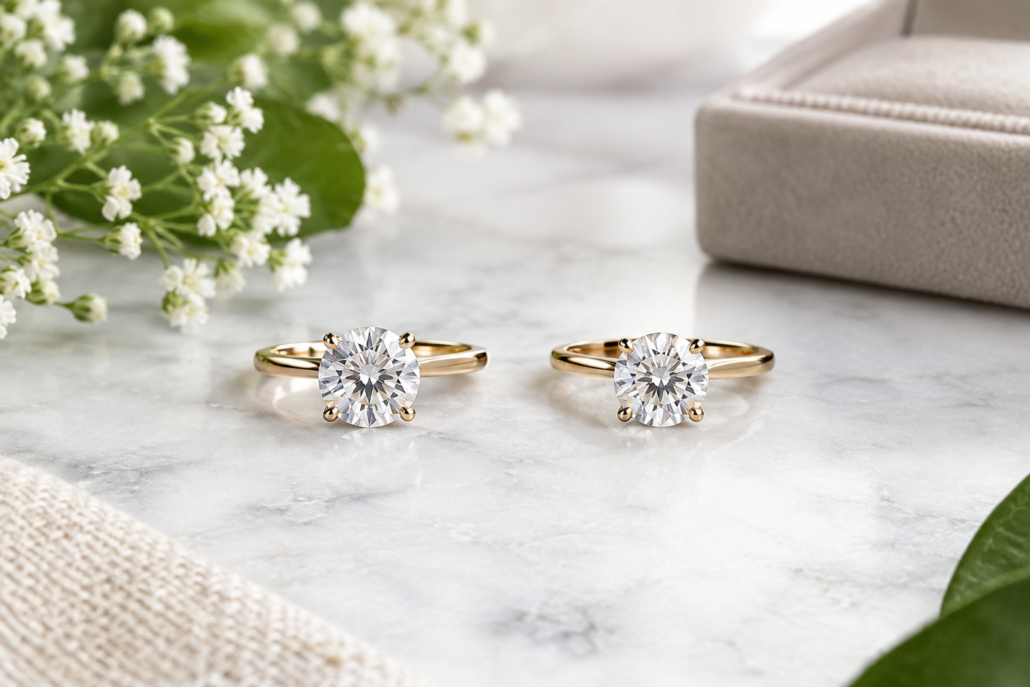
A one carat round brilliant in G color and VS1 clarity costs roughly $4,500 to $6,500 as a mined stone in 2026, and somewhere between $800 and $1,900 if it was grown in a lab. Both are real diamonds, chemically and optically identical, and neither one looks different on a hand across a dinner table. Choosing between natural and lab-grown diamonds for your engagement ring comes down to what you want that budget to do, and how you feel about origin.
What Actually Separates the Two Stones
A natural diamond crystallized in the earth’s mantle one to three billion years ago, then rode a volcanic eruption close enough to the surface for someone to find it. A lab grown diamond is made in a reactor over two to twelve weeks, using either High Pressure High Temperature presses that mimic mantle conditions, or Chemical Vapor Deposition, which builds a crystal layer by layer from carbon-rich gas.
The end product is the same material: pure crystallized carbon, 10 on the Mohs scale, the same refractive index of 2.42. The Gemological Institute of America grades both on the same 4Cs scale, and a jeweler cannot tell them apart with a loupe. Separation requires lab equipment that reads growth patterns, fluorescence and trace nitrogen.
The Price Gap and Why It Keeps Widening
Lab grown prices have fallen roughly 80 to 90 percent since 2016 because production capacity expanded faster than demand, especially for CVD stones above one carat. Natural diamond prices move with mine supply and global demand, so they drift rather than collapse.
That gap changes what you can buy at a fixed number. At a $6,000 budget in 2026, most couples are choosing between these options:
- A natural diamond near 0.90 to 1.10 carats, often in H or I color and SI clarity, set in a simple solitaire.
- A lab grown diamond of 2.00 to 2.50 carats in F color and VS clarity, with money left for a diamond band.
- A smaller natural center of 0.70 carats in an elaborate custom setting with hand engraving and side stones.
None of those is the correct answer. They are three different priorities, and the right one depends on whether size, origin or craftsmanship matters most to the person wearing it. Our guide on how to choose an engagement ring walks through setting that budget before you start looking at stones.
For a closer look at this topic, see our guide: The Art of Custom Jewelry Design: Bringing Your Dream Engagement Ring to Life.
Resale Behaves Very Differently
This is the part most comparison articles skim. A natural diamond typically resells for 25 to 50 percent of retail through a reputable buyer, and high-color stones above two carats hold the upper end of that range. Lab grown resale is far weaker right now, commonly 10 to 30 percent, partly because new production keeps getting cheaper and partly because the secondhand market is still thin.
Most people never sell an engagement ring, so this matters less than it sounds. It does matter if you are buying a large center stone you might upgrade later, or if you think of the purchase partly as an asset. Trade-up programs at the store where you bought the ring usually offer better terms than open-market resale for either type.
Sourcing Claims Deserve a Closer Read
Lab grown marketing leans heavily on environmental and ethical advantages, and some of it holds up while some of it does not. Growing a diamond takes significant electricity, and the footprint depends on whether that grid runs on coal or renewables, which producers rarely disclose in detail.
On the natural side, the Kimberley Process covers conflict financing but does not address labor conditions or environmental restoration. Countries like Botswana and Namibia channel diamond revenue into public spending, which is a genuine argument for mined stones. The FTC Jewelry Guides require sellers to disclose lab origin clearly and restrict vague terms like “eco-friendly” without substantiation, so read any sustainability claim for specifics rather than adjectives.
Four Questions That Settle It for Most Couples
- Does origin story matter to your partner? Some people care deeply that the stone formed in the earth. Others find the lab origin genuinely appealing. Ask indirectly if you want the proposal to stay a surprise.
- Is there a carat number in their head? If they have described a two carat stone, lab grown gets you there at a fraction of the cost.
- Will you upgrade later? Buyers planning a five or ten year anniversary upgrade often lean natural for the trade-in math.
- Where does the rest of the budget go? A heavier platinum setting, a hand-forged basket or a matching band can matter more day to day than a quarter carat.
Quality Still Varies Within Each Category
Choosing lab grown does not mean quality stops mattering. Cut grade drives roughly 60 percent of visible brilliance, and a poorly cut lab stone looks dull next to a well-cut natural one of half the size. Ask for an Excellent or Ideal cut grade, and look at the stone under diffused light rather than the spotlights jewelry cases use.
We cover this topic in more depth in Understanding the 4 Cs: A Beginner’s Guide to Diamond Quality and Brilliance.
Some lab grown material shows a faint blue or gray cast from boron or nitrogen during growth, more common in older HPHT production. Current CVD stones in the D to F range are typically clean and colorless. If you are comparing lab grown diamonds in Boston, view several in person before committing to a certificate number.
Metal and Setting Shift the Decision Too
Warm metals mask slight tints, which means an I or J color diamond, natural or lab, often faces up beautifully in yellow gold while looking faintly warm in platinum. If you are still deciding on the band, our comparison of yellow gold and rose gold engagement rings covers how each metal reads against different skin tones.
Halo and pavé designs also change the calculation, since dozens of small accent diamonds are inexpensive in lab grown form. Couples browsing engagement rings in Waltham, MA and engagement rings in Quincy, MA often mix the two: a natural center with lab grown accents, or the reverse.
Frequently Asked Questions
Should You Buy a Natural or Lab Grown Diamond?
Buy natural if origin, rarity or resale value matters to you, and buy lab grown if you want maximum size and clarity for your budget. Roughly half of US engagement ring buyers now choose lab grown, and both stones carry the same hardness, sparkle and grading standards.
Is Meghan Markle’s Diamond Lab Grown?
No, the center stone in Meghan Markle’s 2017 engagement ring is a natural diamond sourced from Botswana. The two side stones came from Princess Diana’s personal collection, and the ring was later reset on a thinner pavé band.
Are Tiffany Diamonds Lab Grown?
No, Tiffany & Co. sells natural diamonds in its engagement rings and has publicly declined to stock lab grown center stones. The company publishes the region of origin for its individually registered diamonds above 0.18 carats.
How Much Is a 1 Carat Lab Grown Diamond Worth?
A one carat lab grown diamond typically retails between $800 and $1,900 in 2026, depending on cut, color and clarity. The same specifications in a natural stone usually run $4,500 to $6,500, and resale on the lab grown version is generally 10 to 30 percent of what you paid.
See Both Stones Side by Side Before You Decide
Photographs and spec sheets flatten the differences that matter, so compare a natural and a lab grown stone in person, in daylight, at the carat weight you are considering. Sevag Zargarian can pull options in both categories and build the setting around whichever one you choose.

